

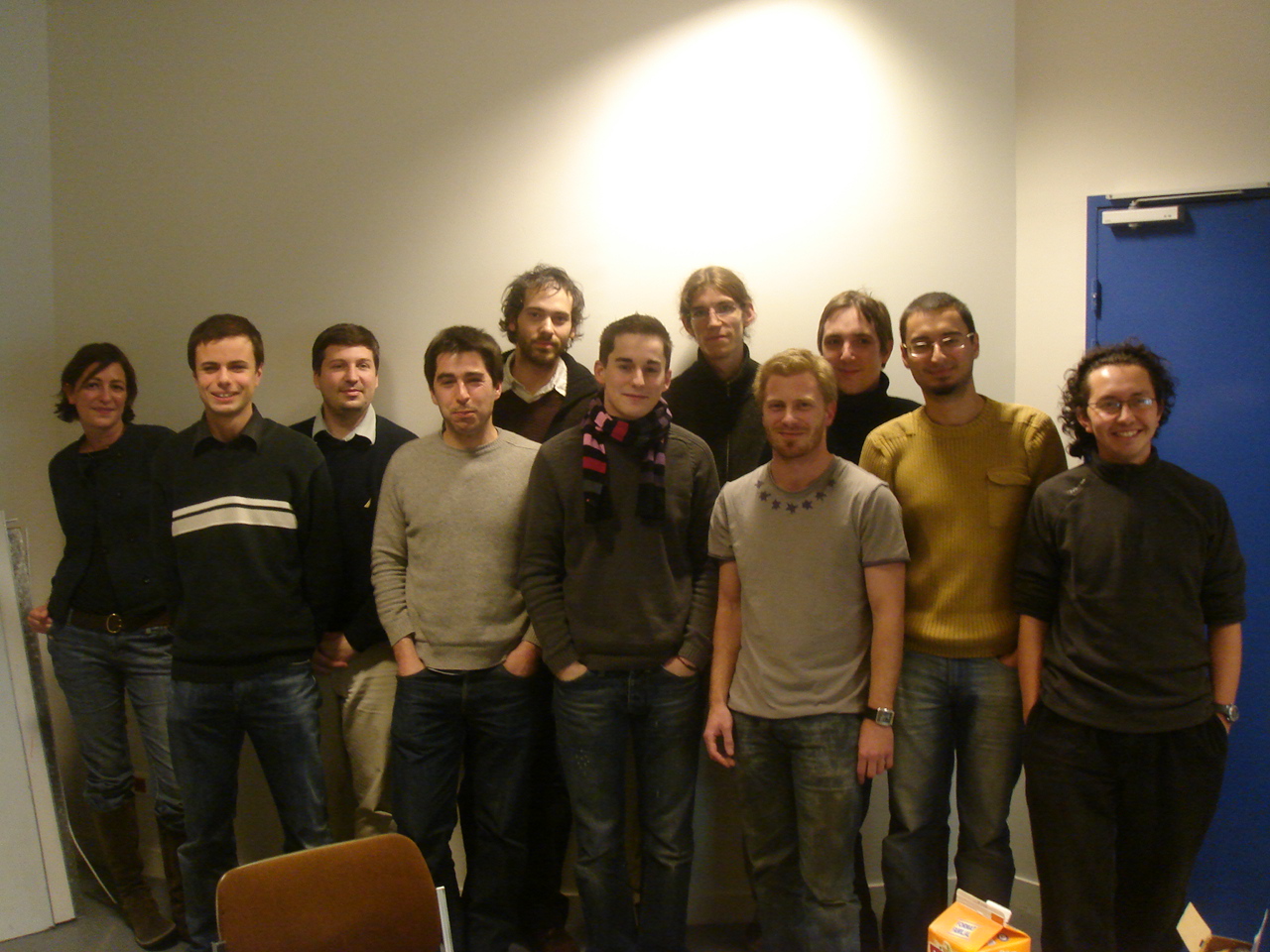
Members(co-supervision)
Faculty:
-Elsa Angelini
-Isabelle Bloch
Post-doctoral fellow(s):
- Jérémie Anquez
- Lazar Bibin
- Erkut Erdem (Univ. Paris Jussieu)
- Youssef Rouchdy
Research Engineer:
- Juan Pablo De La Plata Alcade
PhD students:
- Stéphane Audière (Echosens)
- Jérôme Baussé
- Geoffroy Fouquier
- Itebeddine Ghorbel (LIP6)
- Marcio Marim (Institut Pasteur)
- Giovani Palma (GE)
- Guillaume Pizaine (Philips Heathcare)
- Maria Carolina Vanegas Orozco
- Nicolas Widinski
- Julien Wojak
Seminar Schedule
Thursday Feb 18th 17h30 -C06
Speaker: J. P. De la Plata
Title: ISBMS overview
Friday Feb 12th 14h00 -C47
Speaker: J. Wojak et N. Widinski
Title: RFIA overview
Friday Feb 5th 17h30 -C06
Speaker: Y. Rouchdy
Title: Segmentation and tracking of deformable structures in biomedical images
Summary: My presentation is divided into three sections: I will present work from my Ph.D and two previous postdocs. All three projects concerned the segmentation of deformable structures in biomedical images. In the first section, I will present an non-linear elastic model for the segmentation of the heart ventricles in MR images that I developed during my thesis, see [1]. This model uses geometrical constraints to guide the deformation of a mesh, and a prior shape placed into the image, towards the boundary of the heart ventricles. The mesh is deformed under a force field computed from the image. The second part concerns the segmentation of microglia extensions from confocal images with geodesic methods. These methods are based on the Fast marching method, Harris points and a novel geodesic method, geodesic voting [2]. These methods are all adapted to segment automatically tree structures. Finally, I will present work from my last post-doc on the mapping of the brain connectivity in Diffusion Tensor Images (DTI). I will also present results of a group analysis comparing healthy and schizophrenic individuals and a study of white maturation in mouse brain [3].
[3] Y. Rouchdy, J. Pousin, J. Schaerer and P. Clarysse. Spatio-temporal segmentation of the heart ventricles from MRI using a 3D non-linear elastic model. Inverse Problems 23(3), pages 1017-1036, 2007.
[2] Y. Rouchdy and L. D. Cohen. Segmentation of deformable tree structures by geodesic voting. The 19th International Conference on Pattern Recognition. Tampa, Florida, 2008.
[3] Y. Rouchdy, C. Davatzikos, and V. Ragini. Connectivity-based group analysis of white matter maturation in mouse brain. To be submitted.
Thursday Jan 14 17h00 - C06
Speaker: J. Wojak
Title: MIA overview
Friday Dec 18 17h30 - C06
Speaker: E. Angelini
Title: MICCAI overview
Friday Dec 10 17h30 - C06
Speaker: J. Anquez
Title: MICCAI Workshop overview
Friday Nov 27th16h00 -C06
Speaker: Stéphane Audière
Title: Ultrasound Elastography
Friday Nov 20th 17h30 - C06
Speaker: G. Pizaine (Philips Healthcare)
Title: Déformations avec Modèles Masses-Ressorts
Thursday Nov 12th 15h00 -
Speaker: Alexandre Gramfort, INRIA Saclay, Equipe PARIETAL
Title: How to map and track cortical activations with M/EEG using sparse
priors and graph cuts
Abstract: Magneto and electroencephalography (M/EEG) can measure every millisecond the electromagnetic fields produced by the brain. From these measurements, the challenge is to localize in space, but also in time, the active brain regions that have generated the measured signal. After a short introduction to the biological basis and the physics principles enabling the acquisition of M/EEG data, we will detail the mathematical and computational aspects of the problem of brain source localization with M/EEG. When considering distributed source models, the problem addressed is equivalent to a strongly ill-posed deconvolution problem, for which a priori knowledge needs to be used. We will focus on priors leading to convex optimization problems for which we will present general optimization strategies based on proximity operators. We will show how this framework allowed us to provide a solution to the problem of retinotopic mapping with MEG data. We will then detail a graph-cut based approach to track cortical activations over time. Keywords: MEG, EEG, Brain Functional Imaging, Inverse Problems, Convex optimization, Proximal operators, Graph-Cuts Optimization
Friday Oct 30th 17h30 - C06
Speaker: N. Windinski,
Title: GRETSI overview
Friday Oct 23th 17h30 - C06
Speaker: I. Ghorbel, C. Vanegas
Title: GRETSI overview - COSIT overview
Friday Oct 16th 17h00 - C06
Speaker: Marcio Marim
Title: Overview of GRETSI
Tuesday Sept. 29th, 10h00- C47
Speaker: Juan Pablo De La Plata
Ttitle: SOFA: Un logiciel libre pour des simulations médicales
Abstract:
SOFA :
- Introduction sur SOFA (motivations, structure, technologie utilisée)
- Implémentations sur GPU, OGRE
.
- Mes contributions au logiciel.
- Projet pour Telecom ParisTech: Modélisation de femme enceinte pour la dosimétrie: Utilisation du logiciel SOFA pour contrôler le réalisme et les modes de variabilité du corps de la femme enceinte.
Friday Sept. 25th: 16h00 - C06
Speaker: Lazar Bibin
Title: Overview of conferences Computer Assisted Radiology and Surgery (CARS) and World Congress on Medical Physics and Biomedical Engineering (WC).

Friday Sept. 11th: 14h00 - C47
Speaker: Xavier Bresson
Title: Total Variation, Relaxation & Convex Optimization for Image
Segmentation & Graph Clustering
Abstract: In this talk, I will introduce two algorithms for image
segmentation and graph clustering. One of the most influential image
segmentation models is the Mumford-Shah’s model (1800 citations).
Several algorithms such as the level set method have been introduced to
compute a minimizing solution to the MS’s problem, but none of them can
compute a global solution. We introduce a convex formulation for the
multiphase piecewise constant MS problem (which is equivalent to the
NP-hard problem of Potts in the discrete literature) and compute exact
global minimizing solutions. We believe our method is the first in the
literature that can make this claim. The second model will focus on
graph clustering, which aims at grouping similar high-dimensional data
s.a. images. The main problem of graph clustering is to minimize a cut
of the graph. Popular cuts are the normalized cut of Shi-Malik (3000
citations) and the Cheeger’s cut, which are NP-hard problems. We
introduce a continuous relaxation of the Cheeger’s cut problem and we
show that the relaxation is actually equivalent to the original problem,
which is not the case with the Shi-Malik’s relaxation. We also give an
algorithm which is experimentally very efficient on some clustering
benchmarks since the algorithm can cluster 10,000 high-dimensional
points in a few seconds.
This is joint work with T. Chan (NSF & UCLA), E. Brown, T. Goldstein, S.
Osher (UCLA), and A. Szlam (NYU).
Friday June 19th 2009: 14h00, C06
Speaker: Nicolas & Co
Title: Journal Club
Tuesday June 9th 2009: 17h00, C06
Speaker: Elsa Angelini
Title: FIMH overview
presentation pdf
Tuesday June 2nd 2009: 11h00, C06 -
Speaker: Marcelo Hashimito
Title: Object Detection by Keygraph Classification
Object detection consists in the problem of deciding whether a model belongs to a scene and, if it does, calculate its exact pose. Since the ground-breaking work of Schmid and Mohr (1997), it is known that keypoint-based approaches can be very effective in solving this problem. Such approaches consist in ignoring the majority of the points in the model and the scene and focusing only on a subset of special points that can be detected and descripted consistently even under variations of scale, rotation and brightness. Those keypoints are classified individually and eventual misclassifications can be filtered through a robust pose estimator.
On this seminar we will present an alternative framework on which the individual classification of keypoints is replaced by the classification of graphs whose vertices are keypoints. Such keygraphs present three advantages: (a) allow the extraction of relational descriptors, which are more naturally robust; (b) allow a simpler scheme for pose estimation and (c) allow a fine tuning of the implementation according to the complexity of the detection problem. The risk of combinatorial explosion can be circunvented through a combination of polygonal meshing, structural constraints and part-based classification schemes. Preliminary results with implementations based on three-vertex keygraphs and four-vertex keygraphs suggest that the framework can be fast enough for real-time frame-by-frame detection on videos.
Wednesday May 27th 2009: 16h00, C06 -
Speaker: Julien Wojak
Title: Region-based deformable model and shape caracterization with Legendre polynomials.
Tuesday May 19th 2009: 16h30 C06
Speaker: all
Title: let's just have a group discussion
Faculty:

-Elsa Angelini
-Isabelle Bloch
Post-doctoral fellow(s):
- Jérémie Anquez
- Lazar Bibin
- Erkut Erdem (Univ. Paris Jussieu)
- Youssef Rouchdy
Research Engineer:
- Juan Pablo De La Plata Alcade
PhD students:
- Stéphane Audière (Echosens)
- Jérôme Baussé
- Geoffroy Fouquier
- Itebeddine Ghorbel (LIP6)
- Marcio Marim (Institut Pasteur)
- Giovani Palma (GE)
- Guillaume Pizaine (Philips Heathcare)
- Maria Carolina Vanegas Orozco
- Nicolas Widinski
- Julien Wojak
Seminar Schedule
Thursday Feb 18th 17h30 -C06
Speaker: J. P. De la Plata
Title: ISBMS overview
Friday Feb 12th 14h00 -C47
Speaker: J. Wojak et N. Widinski
Title: RFIA overview
Friday Feb 5th 17h30 -C06
Speaker: Y. Rouchdy
Title: Segmentation and tracking of deformable structures in biomedical images
Summary: My presentation is divided into three sections: I will present work from my Ph.D and two previous postdocs. All three projects concerned the segmentation of deformable structures in biomedical images. In the first section, I will present an non-linear elastic model for the segmentation of the heart ventricles in MR images that I developed during my thesis, see [1]. This model uses geometrical constraints to guide the deformation of a mesh, and a prior shape placed into the image, towards the boundary of the heart ventricles. The mesh is deformed under a force field computed from the image. The second part concerns the segmentation of microglia extensions from confocal images with geodesic methods. These methods are based on the Fast marching method, Harris points and a novel geodesic method, geodesic voting [2]. These methods are all adapted to segment automatically tree structures. Finally, I will present work from my last post-doc on the mapping of the brain connectivity in Diffusion Tensor Images (DTI). I will also present results of a group analysis comparing healthy and schizophrenic individuals and a study of white maturation in mouse brain [3].
[3] Y. Rouchdy, J. Pousin, J. Schaerer and P. Clarysse. Spatio-temporal segmentation of the heart ventricles from MRI using a 3D non-linear elastic model. Inverse Problems 23(3), pages 1017-1036, 2007.
[2] Y. Rouchdy and L. D. Cohen. Segmentation of deformable tree structures by geodesic voting. The 19th International Conference on Pattern Recognition. Tampa, Florida, 2008.
[3] Y. Rouchdy, C. Davatzikos, and V. Ragini. Connectivity-based group analysis of white matter maturation in mouse brain. To be submitted.
Thursday Jan 14 17h00 - C06
Speaker: J. Wojak
Title: MIA overview
Friday Dec 18 17h30 - C06
Speaker: E. Angelini
Title: MICCAI overview
Friday Dec 10 17h30 - C06
Speaker: J. Anquez
Title: MICCAI Workshop overview
Friday Nov 27th16h00 -C06
Speaker: Stéphane Audière
Title: Ultrasound Elastography
Friday Nov 20th 17h30 - C06
Speaker: G. Pizaine (Philips Healthcare)
Title: Déformations avec Modèles Masses-Ressorts
Thursday Nov 12th 15h00 -
Speaker: Alexandre Gramfort, INRIA Saclay, Equipe PARIETAL
Title: How to map and track cortical activations with M/EEG using sparse
priors and graph cuts
Abstract: Magneto and electroencephalography (M/EEG) can measure every millisecond the electromagnetic fields produced by the brain. From these measurements, the challenge is to localize in space, but also in time, the active brain regions that have generated the measured signal. After a short introduction to the biological basis and the physics principles enabling the acquisition of M/EEG data, we will detail the mathematical and computational aspects of the problem of brain source localization with M/EEG. When considering distributed source models, the problem addressed is equivalent to a strongly ill-posed deconvolution problem, for which a priori knowledge needs to be used. We will focus on priors leading to convex optimization problems for which we will present general optimization strategies based on proximity operators. We will show how this framework allowed us to provide a solution to the problem of retinotopic mapping with MEG data. We will then detail a graph-cut based approach to track cortical activations over time. Keywords: MEG, EEG, Brain Functional Imaging, Inverse Problems, Convex optimization, Proximal operators, Graph-Cuts Optimization
Friday Oct 30th 17h30 - C06
Speaker: N. Windinski,
Title: GRETSI overview
Friday Oct 23th 17h30 - C06
Speaker: I. Ghorbel, C. Vanegas
Title: GRETSI overview - COSIT overview

Friday Oct 16th 17h00 - C06
Speaker: Marcio Marim
Title: Overview of GRETSI

Tuesday Sept. 29th, 10h00- C47
Speaker: Juan Pablo De La Plata
Ttitle: SOFA: Un logiciel libre pour des simulations médicales
Abstract:
SOFA :

- Introduction sur SOFA (motivations, structure, technologie utilisée)
- Implémentations sur GPU, OGRE
. - Mes contributions au logiciel.
- Projet pour Telecom ParisTech: Modélisation de femme enceinte pour la dosimétrie: Utilisation du logiciel SOFA pour contrôler le réalisme et les modes de variabilité du corps de la femme enceinte.
Friday Sept. 25th: 16h00 - C06
Speaker: Lazar Bibin
Title: Overview of conferences Computer Assisted Radiology and Surgery (CARS) and World Congress on Medical Physics and Biomedical Engineering (WC).

Friday Sept. 11th: 14h00 - C47
Speaker: Xavier Bresson
Title: Total Variation, Relaxation & Convex Optimization for Image
Segmentation & Graph Clustering
Abstract: In this talk, I will introduce two algorithms for image
segmentation and graph clustering. One of the most influential image
segmentation models is the Mumford-Shah’s model (1800 citations).
Several algorithms such as the level set method have been introduced to
compute a minimizing solution to the MS’s problem, but none of them can
compute a global solution. We introduce a convex formulation for the
multiphase piecewise constant MS problem (which is equivalent to the
NP-hard problem of Potts in the discrete literature) and compute exact
global minimizing solutions. We believe our method is the first in the
literature that can make this claim. The second model will focus on
graph clustering, which aims at grouping similar high-dimensional data
s.a. images. The main problem of graph clustering is to minimize a cut
of the graph. Popular cuts are the normalized cut of Shi-Malik (3000
citations) and the Cheeger’s cut, which are NP-hard problems. We
introduce a continuous relaxation of the Cheeger’s cut problem and we
show that the relaxation is actually equivalent to the original problem,
which is not the case with the Shi-Malik’s relaxation. We also give an
algorithm which is experimentally very efficient on some clustering
benchmarks since the algorithm can cluster 10,000 high-dimensional
points in a few seconds.
This is joint work with T. Chan (NSF & UCLA), E. Brown, T. Goldstein, S.
Osher (UCLA), and A. Szlam (NYU).
Friday June 19th 2009: 14h00, C06
Speaker: Nicolas & Co
Title: Journal Club
Tuesday June 9th 2009: 17h00, C06
Speaker: Elsa Angelini
Title: FIMH overview
presentation pdf
Tuesday June 2nd 2009: 11h00, C06 -
Speaker: Marcelo Hashimito
Title: Object Detection by Keygraph Classification
Object detection consists in the problem of deciding whether a model belongs to a scene and, if it does, calculate its exact pose. Since the ground-breaking work of Schmid and Mohr (1997), it is known that keypoint-based approaches can be very effective in solving this problem. Such approaches consist in ignoring the majority of the points in the model and the scene and focusing only on a subset of special points that can be detected and descripted consistently even under variations of scale, rotation and brightness. Those keypoints are classified individually and eventual misclassifications can be filtered through a robust pose estimator.
On this seminar we will present an alternative framework on which the individual classification of keypoints is replaced by the classification of graphs whose vertices are keypoints. Such keygraphs present three advantages: (a) allow the extraction of relational descriptors, which are more naturally robust; (b) allow a simpler scheme for pose estimation and (c) allow a fine tuning of the implementation according to the complexity of the detection problem. The risk of combinatorial explosion can be circunvented through a combination of polygonal meshing, structural constraints and part-based classification schemes. Preliminary results with implementations based on three-vertex keygraphs and four-vertex keygraphs suggest that the framework can be fast enough for real-time frame-by-frame detection on videos.
Wednesday May 27th 2009: 16h00, C06 -
Speaker: Julien Wojak
Title: Region-based deformable model and shape caracterization with Legendre polynomials.
Tuesday May 19th 2009: 16h30 C06
Speaker: all
Title: let's just have a group discussion
Coming
Up....